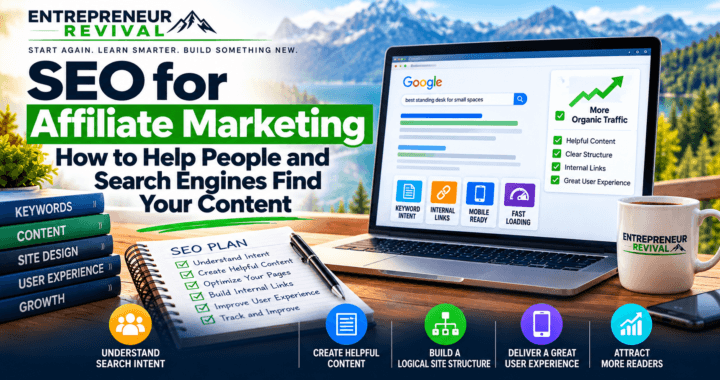
SEO for Affiliate Marketing: How to Help People and Search Engines Find Your Content
You can write an excellent affiliate article and still struggle to attract readers if your website is difficult to understand, your content doesn’t match what people are searching for or your pages aren’t connected logically. SEO helps organize and present useful content so both people and search engines can understand what your site offers.
Quick Answer
SEO for affiliate marketing is not about finding tricks that force pages to the top of Google. It starts with understanding what your audience is searching for, creating genuinely useful content around those needs, organizing related articles logically, making your website easy to use and helping search engines discover and understand your pages.
If you’re still learning how the business model works, start with our beginner’s guide to affiliate marketing.
SEO Starts After You Decide Who You’re Helping
A common beginner mistake is opening a keyword tool before deciding what the website is actually about.
SEO becomes much easier when your site serves a defined audience and solves a connected group of problems.
Imagine building an affiliate website around small-space home offices. Your audience might need help choosing desks, improving lighting, organizing cables, finding compact storage, improving ergonomics and selecting equipment.
Those subjects naturally belong together.
Compare that with publishing one article about office chairs, another about dog food, another about travel insurance and another about cryptocurrency because each keyword appears to have search traffic.
The second website may have keywords. It doesn’t have a clear purpose.
Entrepreneur Revival Reality Check
SEO should help people discover useful content. It should not determine everything you publish.
Start with your audience and the problems you can genuinely help solve. Then use search research to understand how people describe those problems.
If your niche still isn’t clearly defined, return to How to Choose a Profitable Affiliate Marketing Niche before building a large content library.
What SEO Actually Does for an Affiliate Website
Search engine optimization helps improve several parts of your website at the same time.
Discovery
Help search engines find pages and understand how they connect.
Relevance
Create pages that address the questions and problems people are actually searching for.
Experience
Make content readable, navigable and useful on the devices people use.
Good SEO therefore overlaps with good website design, useful writing, research and organization.
Search Intent Matters More Than Repeating a Keyword
A keyword tells you what someone typed.
Search intent helps you understand what that person probably wants to accomplish.
| Search | Likely Intent | Useful Content |
|---|---|---|
| What are packing cubes? | Learn | Beginner explanation |
| How to pack with packing cubes | Solve a problem | Tutorial |
| Compression vs regular packing cubes | Compare | Comparison guide |
| Best packing cubes for carry-on | Evaluate products | Buying guide |
| Brand A packing cube review | Evaluate one product | Detailed review |
These searches may involve the same general subject, but the reader expects a different answer from each page.
Trying to make one article rank for every possible intent often produces a page that serves none of them particularly well.
Build Topics, Not Random Keywords
Our affiliate content strategy guide introduced the idea of building content around connected audience problems. SEO strengthens that strategy.
Instead of creating isolated articles, build topic clusters.
Example: Small-Space Home Office Cluster
- How to Set Up a Home Office in a Small Apartment
- Best Compact Desks for Small Spaces
- How to Hide Computer Cables Without Drilling
- Standing Desk vs Sitting Desk
- Best Desk Lamps for Small Workspaces
- How to Organize a Small Home Office
Each page answers a different question while supporting the same audience.
This also gives you natural opportunities to connect related pages through internal links.
Internal Links Help Build the Learning Journey
Internal links are links from one page of your website to another.
They help visitors continue learning and help search engines discover and understand relationships between pages.
But internal linking works best when the link represents a logical next step—not when links are inserted simply because two pages contain similar keywords.
The affiliate marketing cluster you’re reading is an example:
Each article answers the next question a beginner is likely to have.
Before optimizing an article, make sure it’s worth finding.
Learn how to research, structure and write affiliate articles that answer real questions and introduce recommendations naturally.
Learn how to write helpful affiliate content →Create Descriptive Page Titles
A page title should help someone understand what the page offers before they click it.
Clear usually beats clever.
The Ultimate Secret to Changing Your Workspace Forever
Clear:How to Organize a Small Home Office: 12 Practical Ideas
The second version gives readers much more information about what they will find on the page.
Use One Clear H1 and Logical Headings
Your main heading should describe the page’s primary subject.
Then use subheadings to organize the article into understandable sections.
For Entrepreneur Revival, our standard structure remains:
- H1: the primary article title,
- H2: major sections,
- H3: supporting subsections.
This is useful for readers scanning the page and keeps long educational articles easier to navigate.
Write for Humans Before Thinking About Keyword Density
You do not need to force the exact target phrase into every paragraph.
If you’re writing a thorough article about affiliate SEO, related concepts will naturally appear: search intent, internal links, site structure, content, titles, mobile usability and product reviews.
Use your primary phrase where it makes sense, especially in important descriptive areas such as the title and introduction, but don’t damage the writing to hit an arbitrary repetition target.
Entrepreneur Revival SEO Principle
Audience → Problem → Intent → Helpful Content → Clear Structure → Optimization
SEO should strengthen useful content—not replace it.
Your Affiliate Content Needs Original Value
Affiliate websites have an additional challenge: the product already has a merchant page.
If your article simply repeats the manufacturer’s description, specifications and marketing claims, the reader has little reason to need your page.
Instead, add something useful.
Interpretation
Explain what product features mean in practical situations.
Comparison
Help readers understand meaningful differences between alternatives.
Research
Bring together useful information readers would otherwise need to find separately.
Experience
Where applicable, explain your real experience with a product or service.
Limitations
Explain who may not benefit from the recommendation.
Context
Connect the product to the specific problem the reader is trying to solve.
This is also the standard we are applying throughout the Entrepreneur Revival Reviews Hub.
Don’t Pretend You Tested Something You Didn’t
First-hand experience can make a review more useful, but credibility depends on being accurate about how you know what you know.
If you’ve personally used a product, describe relevant experience and provide evidence when appropriate.
If the article is based on research rather than personal testing, say so. Then explain the sources, comparisons and criteria behind your conclusions.
Never imply hands-on testing that didn’t occur.
Make the Website Easy to Navigate
SEO isn’t limited to individual articles.
Visitors should be able to understand where they are and where they can go next.
Entrepreneur Revival now uses several distinct hubs:
- Start Here for the overall journey,
- AI Learning Library for AI education,
- Build for business-building education,
- Opportunities for business models worth researching,
- Resources for guides and tools,
- Reviews for product and platform research, and
- Articles for the complete content library.
That structure gives each major area a specific purpose instead of placing everything into one undifferentiated blog feed.
Mobile Usability Still Matters
A well-written article becomes frustrating if visitors need to pinch, zoom or fight with the layout to read it.
Check your important pages on smaller screens.
Look for:
- readable text,
- comfortable spacing,
- buttons and links that are easy to tap,
- images that resize correctly,
- tables that don’t destroy the layout,
- navigation that remains usable, and
- calls to action that don’t cover the main content.
This is one reason our newer Entrepreneur Revival article templates use responsive layouts rather than fixed desktop designs.
Page Speed Is Part of the Experience
You don’t need to become a web-performance engineer to improve a small affiliate website.
Start with practical improvements:
- resize oversized images before uploading them,
- use modern image formats where practical,
- avoid unnecessary plugins,
- limit scripts you don’t actually need,
- use reliable hosting,
- avoid excessive animations, and
- test important pages on real mobile connections.
Don’t sacrifice the usefulness of the website simply to chase a perfect performance score. The goal is a fast, stable and comfortable experience for real visitors.
Use Images to Support the Article
Images can explain concepts, demonstrate products and make long educational articles easier to understand.
Use descriptive file names and ALT text that accurately explains relevant images.
ALT text should primarily help describe the image—not become another place to stuff keywords.
Be Careful With Affiliate Links
Affiliate links are a normal part of an affiliate business.
Their presence does not mean a page cannot provide useful information. The important issue is whether the article adds genuine value and whether the commercial relationship is handled transparently.
Use clear affiliate disclosures and appropriately identify sponsored or affiliate relationships in your links.
For Google, rel="sponsored" is the preferred qualification for
paid and affiliate links.
Don’t Turn SEO Into a Tool-Buying Contest
SEO tools can help with keyword discovery, site auditing, competitive research and tracking.
They cannot make weak content useful.
A beginner can learn a great deal using Search Console, analytics, search results, customer questions and basic research before paying for multiple subscriptions.
When you’re considering a paid platform or training environment, evaluate whether it solves a real problem in your workflow.
Our Wealthy Affiliate Review looks specifically at one all-in-one training and website platform for beginners interested in affiliate and content businesses.
Use AI as an SEO Research Assistant
AI can help organize SEO work, but it should not become an excuse to publish hundreds of lightly researched pages.
Useful AI-assisted tasks include:
- brainstorming questions an audience may ask,
- grouping related topics,
- identifying possible search intent,
- organizing research notes,
- suggesting internal-link opportunities,
- reviewing an article for unanswered questions, and
- simplifying complicated explanations.
Search volume, product specifications, pricing, platform policies and other facts still need appropriate verification.
You can learn more about practical AI use in the Entrepreneur Revival AI Learning Library.
Entrepreneur Revival AI + SEO Rule
Use AI to accelerate thinking—not manufacture authority.
Research, verification, experience and judgment remain your responsibility.
Measure What Happens After You Publish
Publishing is the beginning of the feedback loop.
Google Search Console can help you understand whether pages are being discovered, indexed and shown for searches.
Analytics can help you understand what visitors do after they arrive.
Over time, watch for:
- indexing status,
- search impressions,
- search queries,
- clicks,
- click-through rate,
- landing-page traffic,
- internal-link behavior,
- affiliate clicks, and
- conversions where appropriate.
Don’t make major decisions from a few days of data. New and updated pages often need time to be crawled, indexed and evaluated.
Update Content Instead of Constantly Creating More
SEO isn’t only about publishing new articles.
Sometimes improving an existing page is more valuable than creating another one targeting nearly the same subject.
Review older content for:
- outdated information,
- broken links,
- old screenshots,
- weak introductions,
- missing internal links,
- poor mobile formatting,
- outdated product recommendations,
- duplicate search intent, and
- sections that no longer help the reader.
This Article Is an Example
You’re reading an updated legacy Entrepreneur Revival article.
Rather than creating another URL about affiliate SEO, we preserved the existing page and rebuilt it around the site’s current audience, content strategy and quality standards.
A Simple SEO Workflow for Affiliate Content
Entrepreneur Revival Affiliate SEO Checklist
- ☐ Does this page solve a specific audience problem?
- ☐ Does the content match the likely search intent?
- ☐ Is the page title clear and descriptive?
- ☐ Is there one clear H1?
- ☐ Are H2 and H3 headings organized logically?
- ☐ Does the article answer the primary question early?
- ☐ Does it provide original value beyond merchant information?
- ☐ Are factual claims verified?
- ☐ Are relevant internal links included?
- ☐ Does the page link naturally to a useful next step?
- ☐ Does the page work properly on mobile?
- ☐ Are images appropriately sized?
- ☐ Does relevant ALT text describe the images?
- ☐ Are affiliate relationships clearly disclosed?
- ☐ Are affiliate links appropriately qualified?
- ☐ Is the page free from unnecessary distractions?
- ☐ Would this page still deserve to exist without an affiliate commission?
Frequently Asked Questions
Is SEO still worth learning for affiliate marketing?
SEO can still be an important discovery channel for useful affiliate content, but it should be treated as part of a broader business strategy rather than a guaranteed source of traffic. Building an audience through email, social media, communities and other channels can reduce dependence on any single traffic source.
How many keywords should I target in one article?
Start with one primary problem or search intent rather than an arbitrary number of keywords. Closely related phrases can naturally appear as you answer the subject thoroughly.
What is more important: SEO or good content?
They work together. Helpful content gives visitors a reason to stay and trust the site, while SEO helps make that content understandable and discoverable. Optimization cannot compensate for content that provides little value.
Do affiliate links hurt SEO?
Affiliate links are a normal monetization method. What matters is creating meaningful content rather than thin pages built primarily around affiliate links and appropriately qualifying commercial links.
Do I need expensive SEO software?
No. Paid tools can improve research and efficiency, but beginners can learn the fundamentals using their own audience research, search results, Google Search Console and other free or low-cost resources.
Can AI do SEO for me?
AI can assist with research, organization, topic development and content analysis. It should not replace verification, original insight or human judgment.
SEO Works Best When the Content Deserves to Be Found
The goal isn’t to create pages for search engines.
The goal is to create useful pages for people and then make those pages easy for search engines to discover, understand and present.
Start with an audience. Understand their problems. Match the content to their intent. Add original value. Connect related pages. Make the website easy to use. Then measure what happens and improve what you’ve already built.
That’s a much stronger foundation than chasing rankings one keyword at a time.
Build Your Affiliate Business From the Foundation Up
SEO works best as part of a connected system. Return to the Entrepreneur Revival Affiliate Marketing Guide to see how niche selection, affiliate programs, content strategy, writing and SEO fit together.
Return to the Affiliate Marketing Guide →