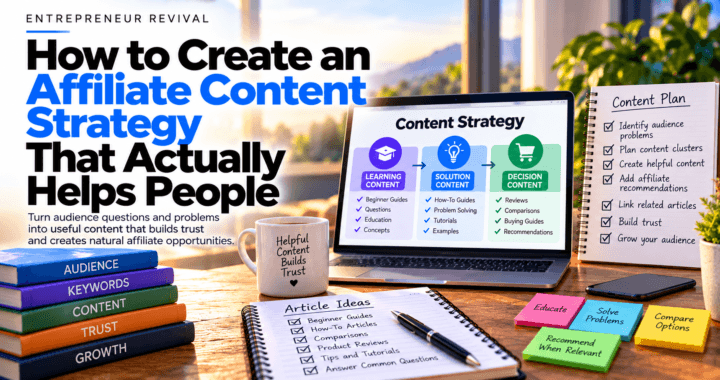
How to Create an Affiliate Content Strategy That Actually Helps People
Affiliate content shouldn’t begin with a product link. It should begin with a person who has a question, problem or decision they need help understanding.
This guide will show you how to turn those audience needs into a practical content strategy that can educate readers, build trust and create natural opportunities for affiliate recommendations.
What is an affiliate content strategy?
An affiliate content strategy is a plan for creating useful content around the questions, problems and purchasing decisions of a specific audience.
Some of that content may contain affiliate recommendations. Much of it may not.
The purpose is to build a useful body of information that attracts the right audience, helps them make decisions and creates relevant opportunities to recommend products or services when those solutions genuinely fit.
New to the business model?
Before planning content, understand how affiliate marketing works, how commissions are generated and why audience trust matters.
Read our beginner’s guide to affiliate marketing →Affiliate content is not content filled with affiliate links.
This distinction matters.
A page doesn’t become useful simply because it contains products, buttons and links.
Strong affiliate content should help someone understand something, solve something, compare something or make a more informed decision.
Sometimes the best answer includes a product.
Sometimes it doesn’t.
Not every article needs to make money directly.
Some of your most useful articles may earn few or no affiliate commissions. Their job may be to attract the right audience, demonstrate expertise, answer an early-stage question or lead readers toward another useful resource.
Start with the audience—not the keyword.
Keywords can be useful.
But a keyword is evidence of a question or need. It isn’t the audience itself.
Suppose your niche is:
Home office organization for people with limited space.
Instead of immediately opening a keyword tool, start by listing what this person might actually struggle with:
- Where do I put a desk in a small room?
- How do I hide cables?
- How do I store office supplies?
- Do I need a monitor arm?
- How can I improve lighting?
- Which desk works in a narrow space?
- How can I work comfortably without a dedicated office?
Now you have the beginning of a content strategy.
Content strategy begins with niche clarity.
If you’re not yet sure which audience or problem area you want to serve, use our research framework before developing your content calendar.
Learn how to choose an affiliate marketing niche →The three types of content an affiliate site needs
A healthy affiliate content strategy shouldn’t consist entirely of “best product” articles.
I prefer thinking about content in three broad groups.
1. Learning Content
Learning content helps someone understand the subject.
Examples:
- What is a monitor arm?
- How much desk space do you need?
- What causes poor home-office lighting?
- What is ergonomic desk height?
These articles may be far from a purchase. That’s okay.
2. Solution Content
Solution content helps someone accomplish or fix something.
Examples:
- How to organize cables under a desk
- How to create storage in a tiny office
- How to improve desk lighting
- How to organize a shared workspace
Products can sometimes appear naturally because they’re part of the solution.
3. Decision Content
Decision content helps someone evaluate options.
Examples:
- Best monitor arms for small desks
- Standing desk vs. regular desk
- Product A vs. Product B
- Is this desk organizer worth buying?
This content is closer to a purchasing decision and may contain more affiliate opportunities.
A simple beginner content mix
Don’t treat these percentages as a search-engine formula. They’re simply a planning tool to prevent your website from becoming a wall of product reviews.
Build a problem map before a content calendar.
A content calendar tells you when to publish.
A problem map tells you what deserves to be published.
Take your audience and divide its problems into themes.
Example: Small Home Office
Theme 1 — Space
Small desks, room layouts, wall storage and compact furniture.
Theme 2 — Organization
Cable management, paperwork, office supplies and clutter.
Theme 3 — Comfort
Chairs, desk height, monitor placement and accessories.
Theme 4 — Lighting
Desk lamps, glare, natural light and video-call lighting.
Theme 5 — Productivity
Focus, workflow, noise and digital organization.
Those themes become your content clusters.
Within each cluster you can create learning, solution and decision content.
Build content clusters instead of random articles.
Random publishing makes it harder for readers—and for you—to understand how your content fits together.
Instead, build groups of closely related articles around a larger problem.
Example cluster: Cable Management
Cornerstone:
Complete Guide to Home Office Cable Management
Supporting article:
How to Hide Cables Under a Desk
Supporting article:
How to Organize Charging Cables
Decision article:
Best Cable Management Trays for Small Desks
Comparison:
Cable Tray vs. Cable Sleeve: Which Is Better?
Each supporting article can link naturally to the larger guide and to other relevant articles.
That’s much more useful than publishing unrelated product reviews with no connection between them.
Internal links should help readers take the next logical step.
Internal linking isn’t simply an SEO task you perform after writing.
It should be part of the content strategy.
For example, this Entrepreneur Revival series follows a natural learning sequence:
Understand Affiliate Marketing
Learn the business model before trying to monetize it.
Choose Your Niche
Identify an audience, problems, demand and potential solutions.
Find Affiliate Programs
Research appropriate products, merchants, commissions and program rules.
Build Your Content Strategy
Turn audience problems into a connected library of useful content.
Haven’t researched your programs yet?
Before building commercial content around products, understand how to evaluate the products, merchants, commissions and rules behind the affiliate relationship.
Learn how to find affiliate programs in your niche →Understand why someone is searching.
Two people searching in the same niche can need completely different information.
| Search | Likely Need | Content Type |
|---|---|---|
| What is a monitor arm? | Understanding | Learning |
| How to position a monitor | Problem solving | Solution |
| Monitor arm vs stand | Comparison | Decision |
| Best monitor arm for small desk | Product selection | Decision |
| Is Brand X monitor arm worth it? | Purchase validation | Review |
Your article should match the reader’s actual need.
Someone asking “what is a monitor arm?” probably doesn’t need 2,000 words of aggressive product recommendations.
Teach first.
What makes a useful affiliate product article?
A good product article should help the reader evaluate the decision—not merely tell them everything is amazing.
Depending on the topic, useful information might include:
- who the product is best suited for,
- who may not need it,
- important features,
- limitations,
- alternatives,
- size or compatibility issues,
- price considerations,
- real user complaints,
- what problem it actually solves, and
- questions to ask before purchasing.
A review doesn’t have to end with “Buy It.”
Sometimes the correct conclusion is that a product fits a specific type of customer but isn’t necessary for everyone. Helping someone avoid the wrong purchase can build more trust than forcing a commission opportunity.
See how Entrepreneur Revival approaches commercial reviews.
Our Reviews Hub separates product and platform evaluation from educational content and focuses on what something does, who it fits, its limitations and whether it deserves consideration.
Explore the Entrepreneur Revival Reviews Hub →How should AI fit into an affiliate content strategy?
AI can make content planning dramatically faster.
It can help you:
- brainstorm audience questions,
- organize problems into clusters,
- develop article outlines,
- identify gaps in your research,
- compare information,
- improve drafts, and
- create repeatable workflows.
But speed creates a temptation:
Publish as much AI-generated content as possible.
That’s not the Entrepreneur Revival approach.
The goal isn’t maximum word production.
The goal is maximum usefulness.
Human direction → AI assistance → research → verification → original value.
Use AI to make your work more capable—not to remove judgment, research or responsibility from the publishing process.
Build AI skills alongside your business skills.
Our AI Learning Library covers beginner AI concepts, prompting, verification and practical business applications without treating AI as a magic business button.
Explore the AI Learning Library →What can you contribute that isn’t already everywhere?
This question becomes increasingly important as AI makes basic information easier to produce.
Original value doesn’t necessarily require expensive laboratory testing.
It can come from:
Experience
What have you personally learned from using a product, solving a problem or working in the niche?
Research
Can you collect and organize information more thoroughly or clearly than existing resources?
Examples
Can you show readers exactly how a concept applies in a realistic situation?
Analysis
Can you explain why one option may fit one person better than another?
Data
Can you responsibly analyze pricing, features, user feedback or other relevant evidence?
Clarity
Can you make a confusing decision easier for a beginner to understand?
Use real customer language to improve your content ideas.
One of the best sources of content ideas is the audience itself.
Look at:
- product reviews,
- YouTube comments,
- Reddit discussions,
- forums,
- social media comments,
- FAQs,
- support questions, and
- search suggestions.
You’re looking for patterns.
What questions appear repeatedly?
What frustrates people?
What do buyers misunderstand?
What do people wish they knew before buying?
Those observations can become better content than simply copying a competitor’s keyword list.
A simple 20-article affiliate content plan
A beginner doesn’t need 500 article ideas.
Start with 20 useful pieces that establish your first content cluster.
Your first 20 articles
Again, this is not an SEO formula.
It’s a starting framework that forces you to build useful informational depth before filling the site with commercial recommendations.
The Entrepreneur Revival content workflow
Problem
Identify the specific audience question or decision.
Intent
Determine what the reader actually needs from the page.
Research
Gather reliable information, examples and audience evidence.
Create
Produce the most useful answer you reasonably can.
Connect
Add relevant internal links and appropriate product solutions.
Verify
Check factual claims, links, products and affiliate disclosures.
Publish
Release the content when it’s genuinely ready to help someone.
Improve
Use reader behavior, search data and new information to update it.
You don’t need every content tool on day one.
A content business can quickly accumulate subscriptions.
Keyword tools. SEO tools. AI tools. Graphics software. Email platforms. Analytics. Affiliate plugins.
Some may eventually be useful.
But start with the problem.
Then buy the tool that solves it.
Before adding another monthly subscription…
Use our Reviews Hub to investigate business tools, AI platforms, training resources and other services as we evaluate them.
Visit the Reviews Hub →If you’re considering an all-in-one affiliate learning environment, you can also read our complete Wealthy Affiliate review to understand its current features, pricing and limitations.
The Entrepreneur Revival Content Checklist
Ask these questions before publishing:
- What specific problem or question does this article address?
- Who is the article for?
- Does the content match what that reader actually needs?
- Did I add something useful beyond information already everywhere?
- Have important facts been verified?
- Are affiliate recommendations genuinely relevant?
- Are commercial relationships clearly disclosed?
- Did I link to useful related content?
- Does the article have a logical next step?
- Would the article still be worth reading without the affiliate links?
Would this page still deserve to exist if there were no affiliate commission?
If the answer is yes, you’re probably moving in the right direction. If the answer is no, the page may need more useful information before it needs more affiliate links.
Content can support more than affiliate marketing.
A useful audience can eventually support multiple appropriate business models.
Depending on the niche, those might include:
- affiliate partnerships,
- digital products,
- services,
- advertising,
- sponsorships,
- email products,
- consulting, or
- other opportunities.
That’s another reason to build content around the audience rather than around one affiliate merchant.
Your audience may support more than one opportunity.
Explore other business models including services, digital products, content businesses and AI-assisted opportunities.
Explore the Opportunities Hub →You can also return to the Entrepreneur Revival Build Hub to compare the major business paths.
Affiliate content strategy FAQ
What content should an affiliate website publish?
A useful affiliate site can combine educational content, problem-solving guides, tutorials, comparisons, buying guides and reviews. The exact mix should reflect the questions and decisions of its audience.
Does every article need affiliate links?
No. Some articles may exist primarily to educate readers, answer questions, build topical depth or lead visitors toward another useful resource.
How many articles should I publish before adding affiliate links?
There is no universal article count. Add affiliate recommendations when they’re relevant to the content and you’re eligible under the program’s requirements. Don’t insert unrelated products simply because the website is new.
Should I only write product reviews?
No. A site made almost entirely of product reviews can miss many questions people ask before they’re ready to purchase. Educational and problem-solving content can help build a more useful resource.
Can AI write my affiliate articles?
AI can assist with research, planning, organization and drafting, but you remain responsible for accuracy, usefulness, originality, disclosure and the final published content.
How long should an affiliate article be?
There is no ideal universal word count. An article should be long enough to satisfy the reader’s question without adding unnecessary material simply to reach a target length.
How often should I publish?
Choose a publishing schedule you can sustain while maintaining quality. Consistency is useful, but publishing more frequently shouldn’t require sacrificing research and usefulness.
Don’t build a website full of links. Build a library worth visiting.
Understand the audience. Map the problems. Create useful answers. Connect related content. Recommend solutions when they genuinely fit—and keep improving what you publish.
Return to the Affiliate Marketing Guide →