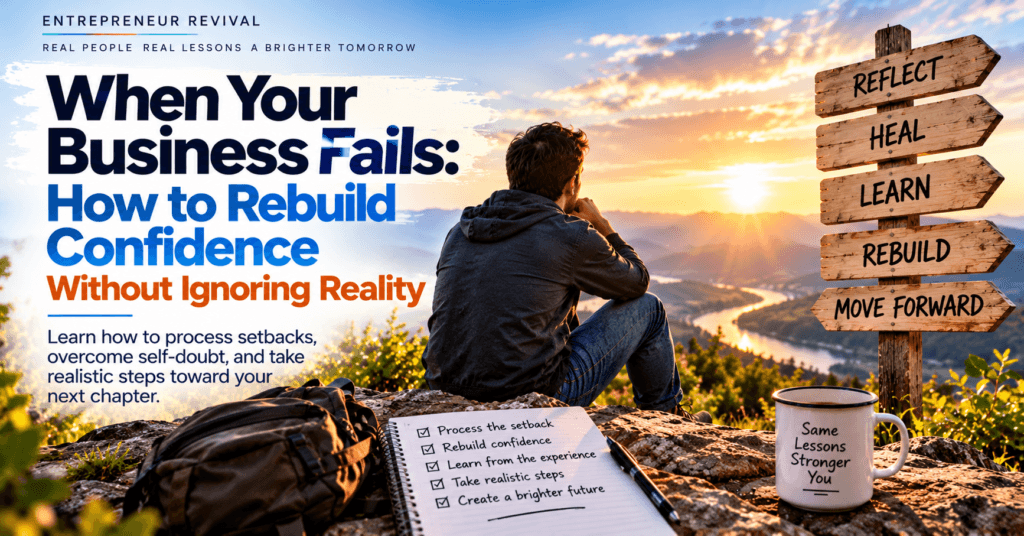
When Your Business Fails: How to Rebuild Confidence Without Ignoring Reality
Business failure can leave you questioning more than your business decisions. It can affect your confidence, your sense of direction, and your willingness to try something new. But rebuilding confidence doesn’t require pretending everything worked out. It begins with understanding what happened, recognizing what you’ve learned, and taking realistic steps forward.
Quick Answer
To rebuild confidence after business failure, begin by separating your personal worth from the outcome of your business. Give yourself time to process the setback, review what went wrong without excessive self-blame, recognize the skills you gained, and take small, manageable actions that restore your sense of capability.
Confidence grows when your decisions are supported by learning, preparation, and evidence—not when you ignore the risks of entrepreneurship.
Business Failure Can Shake Your Identity
When you become an entrepreneur, your business can gradually become part of how you see yourself.
You introduce yourself as a business owner. You talk about your plans. You imagine where the company might be in one year, five years, or even ten years.
You may spend evenings researching ideas, weekends serving customers, and years trying to create something meaningful.
Then the business stops working.
Perhaps sales decline. Expenses become difficult to manage. A partnership ends. Customers disappear. Or the business simply never reaches the point where it can support itself.
The financial consequences can be significant. But the emotional consequences may also affect how you view your abilities and future.
You might ask yourself:
- How did I miss the warning signs?
- Why did I believe this idea would work?
- What will other people think?
- Can I trust my judgment again?
- What if I start another business and fail?
These questions are not unusual responses to a difficult experience. But they can become obstacles when you treat them as proof that you’re incapable of making better decisions.
The challenge is to acknowledge what happened without allowing one business outcome to become your entire identity.
A failed business is an outcome worth understanding—not a permanent definition of the person who built it.
Why Confidence Doesn’t Automatically Return
After a business closes, people may encourage you to move on quickly.
You might hear advice such as “Just start another business” or “Successful entrepreneurs never give up.”
Although intended to be encouraging, those messages can overlook the real consequences of failure.
If you lost savings, damaged relationships, or spent years pursuing an idea that didn’t succeed, starting again may not feel like a simple decision.
Your hesitation may reflect an understandable desire to avoid repeating the experience.
Confidence often requires more than positive thinking. It requires rebuilding trust in your ability to evaluate situations, make decisions, and respond when things don’t go according to plan.
That process can take time.
Entrepreneur Revival Perspective
You don’t need to feel completely confident before taking your next step. You do need enough clarity to make that step responsibly.
Sometimes the next step is researching a new idea. Sometimes it’s rebuilding savings, learning a skill, or taking a break from entrepreneurship.
1. Give Yourself Permission to Process the Setback
Entrepreneurs often feel pressure to stay productive, even when they are dealing with disappointment.
You may immediately begin searching for another opportunity, hoping a new business will make the previous experience feel less painful.
But moving too quickly can prevent you from understanding what the setback means for your finances, priorities, and personal well-being.
Taking time to reflect is not the same as giving up.
You might need to:
- Discuss the experience with someone you trust.
- Organize financial records and unresolved obligations.
- Step away from business-related social media for a while.
- Reestablish routines that support your well-being.
- Decide which business responsibilities need immediate attention and which can wait.
You do not have to turn the experience into a lesson overnight.
And if stress, anxiety, or low mood significantly interfere with daily life, consider seeking support from a qualified mental health professional.
2. Separate Facts From the Story You’re Telling Yourself
After a setback, it’s easy to make broad statements about your abilities.
“I always make bad decisions.”
“I’m not cut out for business.”
“I wasted everything.”
These statements may reflect how you feel in the moment, but they aren’t necessarily accurate descriptions of what happened.
A more useful approach is to distinguish observable facts from personal interpretations.
The Interpretation
“Nobody wanted my business.”
This conclusion may be too broad to explain the actual problem.
The Evidence-Based Question
“How many potential customers did I reach, and what feedback did they provide?”
This question identifies information you can examine.
The Interpretation
“I’m terrible with money.”
This labels the person rather than identifying a specific financial issue.
The Evidence-Based Question
“Which costs did I underestimate, and what financial controls were missing?”
This creates a clearer starting point for improvement.
The purpose isn’t to excuse poor decisions.
It’s to understand them accurately.
You can take responsibility for mistakes without assuming those mistakes define your future potential.
3. Recognize the Skills Your Business Taught You
A business can close without erasing everything you learned while operating it.
Think about the tasks you performed during your entrepreneurial journey.
You may have developed skills in customer service, sales, marketing, budgeting, website management, research, or problem-solving.
Some of those skills may transfer to a new business, a job, or freelance work.
Exercise: Your Entrepreneurial Skills Inventory
Take a sheet of paper and create three columns:
- What I did: List the responsibilities you handled in your business.
- What I learned: Identify the skills or knowledge gained through those responsibilities.
- Where I can use it: Consider how those skills might apply to your next chapter.
Include accomplishments that may seem small. Solving a difficult customer problem or learning to manage a website can still represent useful experience.
This exercise isn’t about convincing yourself that the business succeeded.
It’s about developing a more complete picture of the experience.
4. Stop Comparing Your Setback to Someone Else’s Success
Social media can make entrepreneurship appear like a continuous sequence of successful launches, growing revenue, and exciting announcements.
What you often don’t see are the businesses that closed, the expenses behind the revenue, or the years of experimentation that preceded a successful venture.
Comparing your difficult experience with someone else’s selected highlights may reinforce self-doubt.
Instead, compare your current knowledge with what you understood before starting your previous business.
Ask yourself:
- What business concepts do I understand better now?
- What warning signs would I recognize sooner?
- What questions would I ask before investing money?
- What would I do differently when researching customers?
These comparisons provide a more meaningful measure of your development.
5. Rebuild Confidence Through Small, Manageable Actions
You don’t have to launch another company to begin restoring confidence.
In fact, a large commitment may create unnecessary pressure when you’re still uncertain about your next direction.
Instead, choose activities that help you practice decision-making without taking on substantial risk.
Research One Business Idea
Investigate the customer problem, competition, startup requirements, and potential costs.
Learn One Practical Skill
Improve your understanding of budgeting, marketing, customer research, or website management.
Talk With Potential Customers
Ask thoughtful questions about their needs without immediately trying to sell something.
Complete One Small Project
Finish a realistic task, document what you learned, and use the experience to inform your next decision.
These activities may not generate immediate income.
Their value is in helping you regain a sense of capability through preparation and evidence.
6. Learn the Difference Between Confidence and Certainty
Entrepreneurs make decisions without knowing exactly how the future will unfold.
You cannot guarantee that customers will buy, that competitors will remain the same, or that economic conditions will be favorable.
Confidence does not mean believing everything will work out.
A more realistic form of entrepreneurial confidence is believing you can research an opportunity, recognize warning signs, seek help when needed, and adjust your plans.
Real confidence isn’t the belief that you cannot fail again. It’s the willingness to make thoughtful decisions while accepting uncertainty.
This distinction matters because unrealistic certainty can encourage unnecessary risks.
A thoughtful entrepreneur can remain optimistic while still preparing for unfavorable outcomes.
7. Build a Support System That Encourages Honest Thinking
Entrepreneurship can become isolating, especially after a business closes.
You may hesitate to discuss what happened because you fear criticism or unwanted advice.
But constructive feedback can help you evaluate your experience from a different perspective.
Consider connecting with:
- Experienced small-business owners who can discuss setbacks openly.
- Business mentors who ask practical questions rather than making promises.
- Accountants or legal professionals when financial or contractual issues require expert guidance.
- Friends or family members who can provide personal support.
For U.S. entrepreneurs, SCORE offers business mentoring and educational resources.
You can also explore small-business assistance through the U.S. Small Business Administration.
The goal is not to surround yourself only with people who agree with you.
It’s to find people who can help you think clearly and make better decisions.
8. Decide What Starting Again Actually Means to You
After business failure, it’s tempting to assume that rebuilding confidence must eventually lead to another business launch.
But your next chapter doesn’t have to look like your previous one.
You may decide to pursue employment while learning new business skills.
You may choose a smaller part-time venture.
You may explore a different industry or business model.
Or you may conclude that entrepreneurship isn’t the right priority for your current circumstances.
All of these choices deserve thoughtful consideration.
The important question is whether your decision reflects your present goals, resources, and responsibilities.
If you’re ready to evaluate a possible return to entrepreneurship, our cornerstone guide, How to Restart Your Entrepreneurial Journey After Business Failure, provides a practical framework for reviewing your experience and planning your next steps.
A Seven-Day Confidence Rebuilding Exercise
This exercise is designed to help you regain clarity without pressuring yourself to launch a new venture.
Day 1: Describe What Happened
Write a factual summary of the business setback without using personal labels.
Day 2: Identify Your Feelings
Reflect on what the experience has meant to you and which concerns remain unresolved.
Day 3: List What You Learned
Identify useful skills, business lessons, and insights gained.
Day 4: Recognize Your Strengths
Write down responsibilities you handled well and situations where you demonstrated sound judgment.
Day 5: Identify Your Concerns
List the risks that worry you most and consider which can be reduced through planning.
Day 6: Take One Useful Action
Complete a small task that supports your future direction, such as researching a skill or opportunity.
Day 7: Choose Your Next Step
Decide what you want to explore next without committing to a major launch.
You can complete the exercise at your own pace.
The purpose is not to feel transformed after seven days.
It’s to begin replacing uncertainty with better information and manageable actions.
Common Mistakes to Avoid When Rebuilding Confidence
Trying to Prove Yourself Through Another Launch
A new business should be based on a credible opportunity—not primarily on the need to demonstrate that your previous failure doesn’t define you.
Ignoring Financial Consequences
Positive thinking cannot replace financial planning.
Address outstanding obligations and protect essential living expenses before making another significant investment.
Refusing to Discuss Mistakes
Avoiding uncomfortable lessons can make it harder to recognize similar problems in the future.
Accountability is valuable when it leads to specific improvements.
Assuming Everyone Else Has It Figured Out
Other entrepreneurs may face difficulties that are not publicly visible.
Focus on your own learning and decisions rather than trying to match someone else’s timeline.
Expecting Confidence to Return All at Once
Some days may feel more productive than others.
Rebuilding confidence can be gradual. You can make meaningful progress without feeling certain about every future decision.
Your Confidence Rebuilding Checklist
- ☐ I can describe my previous business outcome without labeling myself a failure.
- ☐ I have identified facts rather than relying only on negative assumptions.
- ☐ I recognize useful skills gained through entrepreneurship.
- ☐ I understand that confidence does not eliminate business risk.
- ☐ I have identified people or resources that can support me.
- ☐ I have considered my financial and personal circumstances.
- ☐ I have chosen one manageable next step.
Frequently Asked Questions
How do I regain confidence after my business fails?
Start by reviewing what happened without treating the outcome as a judgment of your worth. Recognize what you learned, address practical concerns, and complete manageable tasks that help you rebuild trust in your decisions.
Is it normal to be afraid of starting another business?
Fear can be an understandable response to financial loss, disappointment, or uncertainty. The goal isn’t necessarily to eliminate that fear, but to understand your concerns and evaluate whether future risks are manageable.
Should I start another business immediately?
Not necessarily. Consider your finances, unresolved obligations, personal responsibilities, and reasons for restarting. A period of recovery or skill development may be more appropriate.
What if my family doesn’t support me starting again?
Try to understand their concerns, especially when previous business decisions affected shared finances or responsibilities. Discuss specific plans, risk limits, and alternatives rather than asking for unconditional agreement.
Can business failure make someone a better entrepreneur?
A difficult business experience can provide valuable lessons, but improvement is not automatic. It depends on whether the entrepreneur examines what happened and changes relevant decisions or practices.
What if I no longer want to be an entrepreneur?
That is a valid possibility. Your experience may help you identify a different career or lifestyle direction. Rebuilding confidence doesn’t require returning to business ownership.
Your Confidence Can Return Without Rewriting the Past
You don’t need to pretend your business succeeded.
You don’t need to minimize the money you lost, the disappointment you experienced, or the mistakes you made.
Those realities deserve honest attention.
But they do not have to prevent you from learning, developing new skills, or considering future opportunities.
Rebuilding confidence means becoming more capable of making informed decisions, even when outcomes remain uncertain.
Perhaps your next step is reviewing your finances.
Perhaps it’s learning something new.
Perhaps it’s deciding whether another business fits your life.
Whatever you choose, you can move forward without denying what happened.
Continue The Entrepreneurial Comeback Series
Previously in the series: How to Restart Your Entrepreneurial Journey After Business Failure
Coming next — Article #3: 7 Lessons to Learn From a Failed Business Before Starting Again.
Our next article will explore how to examine the decisions, assumptions, and warning signs from a previous venture—and turn those lessons into more informed business planning.
Start Again. Learn Smarter. Build Something New.
Entrepreneur Revival helps aspiring and returning entrepreneurs explore their next chapter through practical education, realistic business guidance, and thoughtful planning.
Explore Your Next Chapter →